Billable utilization: what it is and how to calculate it
Updated 2026-10-24 · Written by the Feestead team
Billable utilization tells you how much of your team's available time turns into work you can invoice. It's the single number that connects time tracking to revenue for agencies, consultancies and professional services firms. Here's the formula, a free calculator, and how to raise it without burning people out.
The formula
Billable utilization = billable hours ÷ available hours × 100
Available hours = contracted working hours − public holidays − vacation − sick days.
Example: a designer works 40 hours a week. In a week with one public holiday, she's available for 32 hours and logs 24 billable hours. Her billable utilization is 24 ÷ 32 = 75%.
Billable utilization calculator
Billable utilization
—
Billable revenue / year
—
Every +5 points is worth
—
What is a good billable utilization rate?
There's no single right number, and published "benchmarks" vary widely by firm type and how they count hours. What holds almost everywhere:
It depends on the role. People who mainly deliver client work carry the highest targets. Project managers, account leads and founders carry lower ones, because sales, hiring and management are real work that nobody pays for directly.
100% is not the goal. A team at 100% has no time for internal projects, learning, proposals or a sick colleague's work. Sustained very high utilization usually shows up later as burnout or write-offs.
Set targets per person, then watch the trend. A drop from 75% to 60% over a month tells you more than any industry average.
Billable utilization vs. billable share
They're easy to mix up. Utilization divides billable hours by available hours. Billable share divides billable hours by hours actually logged. Someone who logs 30 hours in a 40-hour week, 24 of them billable, has 60% utilization but 80% billable share. Low utilization with a high billable share usually means time isn't being logged at all.
How to raise utilization without burning people out
Log time daily. Hours reconstructed on Friday come out lower than what was worked; the missing hours are billable time you never invoice.
Make non-billable time visible. Track internal meetings, admin and sales as non-billable instead of not at all. You can't reduce what you don't see.
Review weekly, per person. Utilization by person and by project, every week, catches overloaded people and idle capacity early.
Fix scoping, not people. Projects that keep running over budget push hours into write-offs. Budget alerts catch them while there's still time to talk to the client.
Invoice what you log. Billable hours that never reach an invoice don't count. Check "not yet invoiced" before every billing run.
See utilization without a spreadsheet
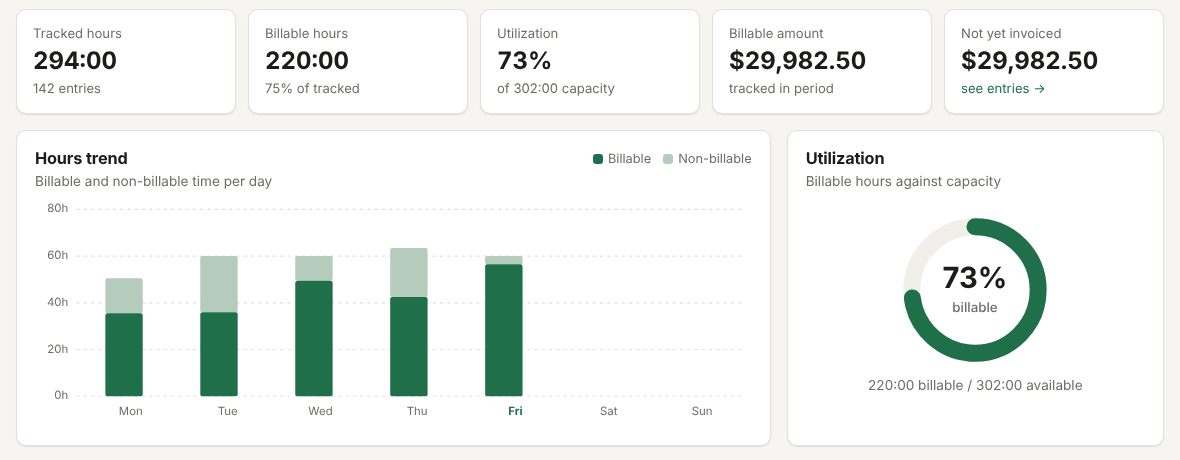
Feestead's dashboard shows billable utilization for the team and for each person, by week or month, next to tracked hours, billable amount and what's not yet invoiced. Capacity comes from each person's weekly hours, so the number updates as people log time.
Example workspace: an 8-person architecture firm, one week.
Paste a Harvest token, import everything, and check every project against Harvest's numbers before you cancel. 7 days free, then $9 per person/month billed yearly ($108/person/year), or $11 monthly, with no usage fees.
The share of a person's available working hours spent on work you can bill to a client. 30 billable hours out of 40 available is 75%.
How do you calculate billable utilization rate?
Billable hours ÷ available hours × 100. Available hours are working hours minus holidays, vacation and sick days.
What is a good billable utilization rate?
It depends on the role: delivery staff have the highest targets, managers and leadership lower ones. Aiming for 100% is a mistake; watch each person's trend over time.
What's the difference between utilization and billable share?
Utilization divides billable hours by available hours; billable share divides them by hours actually logged. A big gap between the two usually means time isn't being logged.